2026
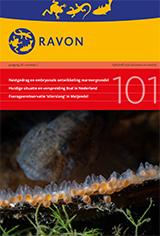
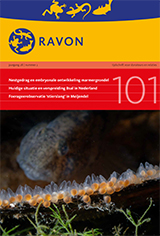
Nestgedrag en embryonale ontwikkeling van de marmergrondel
Publication
Publication
RAVON , Volume 28 - Issue 2 p. 32- 35
Tijdens mijn duiken in 2025 observeerde en fotografeerde ik in drie Nederlandse plassen, de nesten van marmergrondels (Proterorhinus semilunaris). Dit gaf een aantal verrassende inzichten in het gedrag van de mannetjes die het nest verzorgen, de afzet van eieren hierin en de ontwikkeling van larven. Dit artikel beschrijft de observaties en ontwikkelingen over een periode van vier maanden, ondersteund met macrofoto’s van de auteur. Breeding behaviour and embryonic development of the tubenose goby Between mid-May and mid-August 2025, several freshwater lakes in the Netherlands were visited to observe and photograph nests, egg development and breeding behaviour of the tubenose goby (Proterorhinus semilunaris). Most active nests were found between 3 and 6 metres’ depth, with water temperatures ranging from 16 to 22 °C. Multiple nests, egg clusters and larval stages were documented during this period. Macrophotography made it possible to record a continuous series of embryonic stages, from cleavage (the first cell divisions) to the moment the larvae emerged. The eggs were around 2 mm in size and attached to hard substrates (e.g. wood, stones or mussel shells) as a sticky layer. As development progressed, the embryo gradually filled the egg, showing clear organ formation, pigmentation and occasional movement. Newly hatched larvae remained near the nest with a visible yolk sac before seeking shelter in small cavities and structures on the lake bottom. Male tubenose gobies displayed active parental care by guarding the nest and ventilating the eggs with their large pectoral fins. This behaviour helps maintain oxygen flow across the clutch and keep the substrate clean. During the observations, presence and visibility of nests varied strongly between locations, influenced by substrate structure, vegetation density and local conditions. In several nests, di!erent developmental stages were observed, which corresponds with literature stating that females repeatedly deposit eggs during the breeding season. The combination of slow, non-intrusive underwater observation and detailed macrophotography provided a clear insight into the variation in nest locations, embryonic development and breeding behaviour across di!erent freshwater systems in the Netherlands.
| Additional Metadata | |
|---|---|
| , , , , , , | |
| RAVON | |
| CC BY 3.0 NL ("Naamsvermelding") | |
| Organisation | RAVON |
|
F. van den Driesschen. (2026). Nestgedrag en embryonale ontwikkeling van de marmergrondel. RAVON, 28(2), 32–35. |
|