1937
The interpetiolar Inflorencence of Vincetoxicum and Asclepias
Publication
Publication
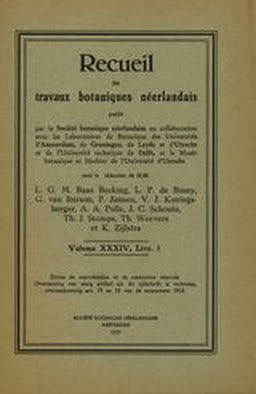
Recueil des travaux botaniques néerlandais , Volume 34 - Issue 1 p. 182- 204
1. The interpetiolar inflorescences of Vincetoxicum, Asclepias and other genera of the Asclepiadaceae, as well as the seemingly axillar inflorescences of many other Asclepiadaceae are all terminal to the main axis or to short members of the sympodial axis. Every sympodium member consists of a thick basal stem part with leafy prophylls, usually two in number, taking part in the construction of the sympodium, and a thinner terminal inflorescence which is pushed aside by the basal part of the next sympodium member. The first sympodium member arises in the axil of the highest leaf of the last vegetative whorl of the vegetative axis, all subsequent sympodial members being borne in the axils of the /3-prophylls. 2. The interpetiolarity (or extra-axillarity) of the inflorescence, where present, is a consequence of the fact that the stem originally has a spiral phyllotaxis from which by means of metatopy a decussate arrangement is formed. The failure of the old morphological school to explain the interpetiolarity is due to the circumstance that this school used to consider the decussation as an original phyllotaxis. In consequence of this lack of success even the well established results have been ignored by modem botanists, who rarely attacked the problem and who, when they did, entirely lost the way. 3. The two highest vegetative leaves of a stem or the two leafy prophylls of a sympodium member having been formed in a spiral position, we may distinguish in the dimerous whorl between an SW (short way)-side and an LW-side. The inflorescence being pushed aside very early by the strong bud from the second leaf, is shifted towards the opposite side. When the strong bud at the time of its expansion activity is still placed more or less in the position based on the spiral phyllotaxis, the inflorescence is pushed towards the LW-side, in the vicinity of the sterile leaf. 4. Besides the expanding influence emanating from the strong bud, there may be similar influences from the weak bud and perhaps from the leaves. Consequently the actual shift direction may be the resultant of a combined action. Actually the divergence between the inflorescence and the sterile leaf which without this combination might not exceed some 20°, often may be higher, up to 60°. 5. If at the time of the crowding aside the metatopic changes have already been completed, the inflorescence is thrown right into the axil of the sterile leaf and consequently there is no interpetiolarity. This condition is realized in many Asclepiadaceae. 6. The sympodial members are always antidromous to their parent axes. They moreover nearly always have their a-prophyll on their right when their spiral is right-handed and reversely, so that the spiral from a runs opisthodromously towards ß. As a consequence the successive inflorescences are placed in two orthostichies in a zigzag. Another consequence is that the spiral arrangement of the strong buds and of the weak buds of the vegetative region is replaced by a zigzag arrangement. As the prophylls of any sympodial member are placed laterally with respect to the inflorescence, the rectangular crossing of the vegetative leaf pairs is replaced by a skew crossing, the angle of which is determined by the degree of extra-axillarity of the inflorescence. 7. In some cases a flowering sympodium may grow out again into a vegetative axis. In such a case the phyllotaxis of this vegetative axis, apart from the metatopies, is the same as that which the next sympodial flowering member should have had. 8. The circumstance that these different morphological phenomena are all readily explained by the assumption of a spiral origin of the decussate phyllotaxis, is a new proof for the validity of such an assumption. 9. Branches from a-prophylls usually are homodromous to their parent axes. As the position of a and /3 is not fixed beforehand, the spiral may be opisthodromous or emprosthodromous.
| Additional Metadata | |
|---|---|
| Recueil des travaux botaniques néerlandais | |
| CC BY 3.0 NL ("Naamsvermelding") | |
| Organisation | Koninklijke Nederlandse Botanische Vereniging |
|
J.C. Schoute. (1937). The interpetiolar Inflorencence of Vincetoxicum and Asclepias. Recueil Des Travaux Botaniques Néerlandais, 34(1), 182–204. |
|