1918
Some numerical proportions in panmictic populations
Publication
Publication
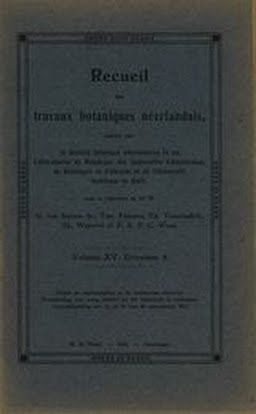
Recueil des travaux botaniques néerlandais , Volume 15 - Issue 4 p. 337- 365
A general and systematic treatment is lacking. Partially this is due to the fact that many investigators reject the use of formulas for living organisms, as nature probably never will follow a rigid scheme, whereas for the other part the imperfectness of our knowledge is the consequence of a certain lack of interest most biologists show for mathematical questions. It is to be regretted that such a general theory does not exist. The different publications do not give a sufficient foundation for such a theory, being too heterogenous of method. Jennings (1916) does not give the derivation of his formulas. Wentworth & Remick (1916), Bruce (1917) and Robbins (1918) are using differential calculation, while Bone (Heukels 1915) obtains his formulas by means of the Gaussian theory of probabilities. None of the authors (Heukels exepted) consider a population with more than one mendelian factor. It is clear that the general theory must have the following qualities: 1°. The method must be homogenous; 2°. The theory must consider populations with an unlimited number of mendelian factors; 3°. All matings must be equally probable, in special cases (as for instance brother and sister mating, inbreeding, sex-linked inheritance etc.) certain combinations equal numerically lo zero.
| Additional Metadata | |
|---|---|
| Recueil des travaux botaniques néerlandais | |
| CC BY 3.0 NL ("Naamsvermelding") | |
| Organisation | Koninklijke Nederlandse Botanische Vereniging |
|
L. Baas Becking. (1918). Some numerical proportions in panmictic populations. Recueil Des Travaux Botaniques Néerlandais, 15(4), 337–365. |
|