1979
Equations relating commonly used morphological measurements of Anax junius (Drury) (Anisoptera: Aeshnidae), including an allometric analysis of size
Publication
Publication
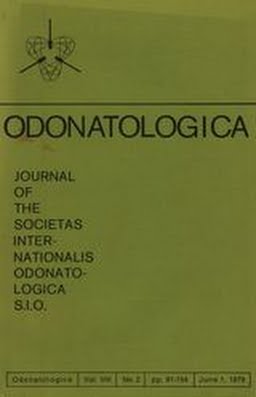
Odonatologica , Volume 8 - Issue 2 p. 103- 109
The prediction equations for conversion between head width, labium length, body length, and wet and dry weight along with the statistical information required for estimating errors and confidence limits are provided. All of the prediction equations (regression analysis) explain greater than 95% of the total variance. — A study of intra-instar variation in 3 morphological parameters suggests that head width is the least variable and generally most practical parameter to measure. – A study of allometric growth was concentrated on the thorax, trying to detect deviations from simple allometry for late instar larvae. No deviations were found, including the lack of a "mature” stage of larval growth which has been reported for a synchronously emerging mayfly sp. (H.F. CLIFFORD, 1970, Can. J. Zoo!. 48: 305-316). As the mature stage mayflies could apparently emerge regardless of body length, Clifford hypothesized that the mature stage aided in synchronizing emergence. The lack of such a stage in A. junius is consistent with the hypothesis because this sp. does not emerge synchronously.
| Additional Metadata | |
|---|---|
| Odonatologica | |
| CC BY-SA 4.0 NL ("Naamsvermelding-GelijkDelen") | |
| Organisation | Societas Internationalis Odonatologica |
|
T.C. Folsom. (1979). Equations relating commonly used morphological measurements of Anax junius (Drury) (Anisoptera: Aeshnidae), including an allometric analysis of size. Odonatologica, 8(2), 103–109. |
|